A Guide to Paper Stocks: How to Choose the Right Paper for Your Printing Project
Likes are remembered in this browser. Clearing cookies or using another device starts fresh.
A Guide to Paper Stocks: How to Choose the Right Paper for Your Printing Project
Why Paper Choice Matters in Printing
Have you ever picked up a book, brochure, or business card and immediately noticed how it felt in your hands?
Sometimes, the paper is smooth and glossy, making photographs and colors appear vibrant. Other times, it has a soft, uncoated texture that makes reading more comfortable. A business card might feel firm and substantial, while a novel may use lighter paper to keep the book manageable.
These differences are not accidental. They are the result of choosing the right paper stock for the intended purpose of the printed material.
Whether you're an independent author preparing your first book, a business producing marketing materials, a school printing educational resources, or an organization preparing a report, your choice of paper affects the appearance, usability, durability, and overall cost of your project.
But with so many paper types, weights, and finishes available, where should you begin?
In this guide, Southern Voices Printing Press explores common paper stocks, what they're best used for, and how to choose the right option for your next printing project.
1. Understanding Paper Stocks: The Basics
A paper stock is the type of paper or paper-based material selected for a printing job. Each stock has different characteristics that influence how it looks, feels, handles ink, and performs in the finished product.
Three important considerations are paper type, paper weight, and paper finish.
Paper type
Paper type refers to the material's general category and surface characteristics. Examples include bond paper, book paper, art paper, and cardstock.
Paper weight
Paper weight is commonly expressed in GSM, or grams per square metre. It measures the weight of a square metre of paper.
Generally, a higher GSM means a heavier sheet, but GSM alone does not determine thickness. Paper composition, density, and manufacturing also affect how thick or rigid a sheet feels.
Paper finish
Paper finish describes the surface of the paper. It may be uncoated, matte-coated, or gloss-coated, among other finishes.
Coated papers generally reproduce photographs and detailed color images more sharply, while uncoated papers offer a more natural surface and are often easier to write on.
Understanding these differences will help you select a paper stock that suits your content and budget.
2. Common Paper Stocks and Their Uses
A. Bond Paper: For Documents and Everyday Printing
Bond paper is a familiar choice for office documents, letters, forms, and other everyday printed materials. It is generally uncoated and provides a practical surface for writing and printing text.
Best used for:
Office documents and business correspondence
School handouts and worksheets
Forms, certificates, and internal reports
Letterheads and administrative materials
Drafts and working documents
Bond paper is especially useful when readability, practicality, and the ability to write on the page are priorities.
For a project that primarily contains text and does not require elaborate photographic reproduction, bond paper may be a sensible option.
Consider this: Bond paper is not automatically the best choice for every book or publication. The appropriate paper depends on the intended use, desired appearance, print method, and production requirements.
B. Book Paper or Offset Paper: For Reading Materials
Book paper is designed for printed publications, while offset paper is a commonly used uncoated paper stock in book and commercial printing. The terms can overlap in everyday printing discussions, although available grades and specifications vary.
Uncoated book and offset papers are popular for materials where reading comfort and practicality matter more than a glossy finish.
Best used for:
Novels and short story collections
Poetry books and literary anthologies
Biographies and memoirs
Academic books and research publications
Manuals, workbooks, and educational materials
Text-heavy nonfiction
For a novel with hundreds of pages, the choice of interior paper affects the finished book's weight, thickness, and reading experience. A lighter stock can help keep a long book manageable, while a heavier or more opaque stock may be preferable when show-through from the reverse side is a concern.
Uncoated paper also offers a natural tactile quality that many readers appreciate.
For authors and independent publishers, the goal is to find a balance between readability, production cost, and the physical character of the finished book.
Consider this: If your book contains extensive photographs, detailed illustrations, or large areas of color, ask your printer whether a coated stock or another paper grade would produce better results.
C. Art Paper: For Images, Colors, and Visual Impact
Art paper is a coated paper commonly used when image quality and color reproduction are important. Its smooth surface helps produce defined details and stronger-looking colors.
Depending on the stock, it may be available in gloss, matte, or other finishes.
Best used for:
Product catalogs and promotional brochures
Photo books and illustrated publications
Corporate profiles and annual reports
Marketing flyers and leaflets
Magazines and image-heavy booklets
Menus featuring food photography
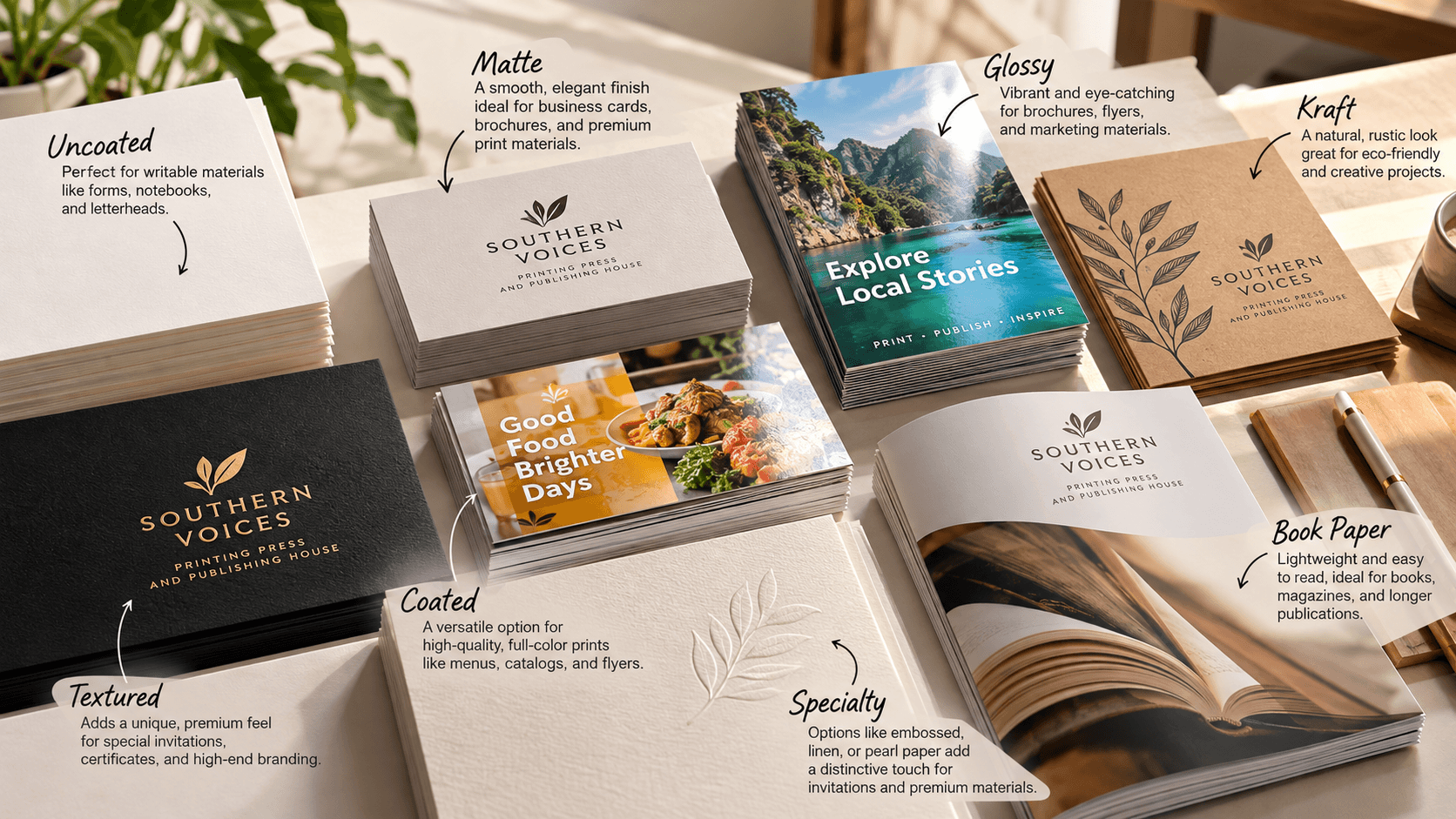
Gloss-coated art paper gives images a reflective, vibrant appearance. Matte-coated art paper offers a smoother, less reflective finish that can be suitable for designs requiring a more understated look.
For example, a restaurant menu with high-quality food photography may benefit from coated paper because it helps images appear crisp and colorful. An art or photography publication may also benefit from a coated stock when accurate visual reproduction is a priority.
Consider this: Coated paper is generally less suitable for writing directly on than uncoated paper. If readers need to fill in information, write notes, or complete worksheets, consider the surface and intended use before deciding.
D. Art Card or Cardstock: For Covers and Sturdier Printed Materials
Art card and other cardstock materials are heavier paper-based stocks commonly used when a printed product needs greater rigidity.
Some art card stocks have a coated surface that helps reproduce graphics and colors effectively. Other cardstocks may have different textures or finishes.
Best used for:
Book covers
Business cards
Postcards and invitation cards
Presentation folders
Product cards and promotional inserts
Packaging sleeves and other printed components
A sturdier stock can help a book cover withstand handling while giving the finished publication a more substantial feel.
For example, a paperback book may use a flexible cover stock selected for both print quality and compatibility with the binding process. A business card, on the other hand, may require a more rigid stock to maintain its shape during frequent handling.
Consider this: The heaviest stock is not always the best. Your printer must consider the product's intended use, folding requirements, finishing options, and binding specifications.
E. Newsprint: For Economical, High-Volume Publications
Newsprint is a lightweight paper commonly associated with newspapers and other publications where economical production is important.
Its appearance and performance differ from higher-grade book or coated paper stocks. It is generally less suited to reproducing photographs with the same sharpness and color intensity as coated paper.
Best used for:
Newspapers
Certain newsletters and community publications
Economical inserts and circulars
Selected high-volume printed materials
Newsprint may be worth considering when a publication prioritizes cost-effective distribution and a familiar newspaper-style appearance.
Consider this: Newsprint is not the default choice for every low-cost printing project. Paper availability, durability, print quality, and the intended lifespan of the material should all be considered.
F. Kraft Paper: For a Natural, Earthy Appearance
Kraft paper is known for its natural brown appearance, although bleached and other variations are also available.
It is often selected for projects where the material's appearance is part of the design. Its visual character can complement minimalist branding, handmade products, and packaging concepts.
Best used for:
Paper bags and packaging
Product tags and labels
Rustic-style invitations and promotional materials
Wrapping and inserts
Selected stationery and branding applications
Kraft paper can be an effective choice for brands that want a natural, understated visual identity.
However, the paper's color affects how printed ink appears. White areas in a design may reveal the paper underneath rather than print as opaque white, unless a suitable white-ink process or other production method is used.
Consider this: Confirm that the chosen kraft stock is compatible with your printing method, desired colors, and finishing requirements.
G. Specialty and Textured Papers: For Distinctive Printed Pieces
Some projects call for paper that does more than carry printed information. Textured, colored, laid, linen-finish, and other specialty stocks can introduce a distinctive tactile quality.
These materials may be appropriate when the physical experience of the printed piece is an important part of the design.
Best used for:
Premium invitations and stationery
Certificates and commemorative materials
Selected art books and special editions
Creative portfolios and presentation pieces
Luxury branding materials
A textured stock can help a publication or printed item stand out, but the paper must work with the design and printing process.
Fine details, small text, and large areas of solid color may reproduce differently on textured surfaces than on smooth paper.
Consider this: Specialty papers can have limited availability and may affect production costs. Check stock availability and request a sample before committing to a large print run.
3. Paper Stock Comparison: Which Type Is Best for Your Project?
Use this quick reference to narrow down your options.
Paper stockCommon applicationsMain advantageImportant considerationBond paperDocuments, forms, worksheetsPractical and writableNot ideal for every image-heavy designBook or offset paperNovels, poetry, manualsNatural reading experienceOpacity and paper weight matterArt paperBrochures, catalogs, photo-heavy materialsStrong image reproductionCoating affects glare and writabilityArt card or cardstockCovers, cards, postcardsGreater rigidityMust suit folding and bindingNewsprintNewspapers, economical publicationsLightweight and practical for specific usesGenerally less durable and less suited to detailed color imageryKraft paperPackaging, tags, creative materialsNatural visual characterPaper color affects printed colorsSpecialty paperInvitations, premium stationery, special editionsDistinctive texture and appearanceCost and availability vary
The right choice depends on the job. A stock that works well for a novel may not be appropriate for a photo-heavy catalog or a business card.
4. What Does GSM Mean, and How Does It Affect Your Printing Project?
GSM stands for grams per square metre. It is one of the most common ways to describe paper weight.
Understanding GSM can help you compare paper options, but it is important not to treat it as a complete measure of paper quality or thickness.
For example, two papers with the same GSM can feel different because of their composition, density, and manufacturing process.
Here are some broad examples of how paper weight categories may be used in printing. These are illustrative ranges, not universal specifications; actual suitability depends on the stock and product.
Approximate GSMTypical applications60–80 GSMLightweight reading paper and selected everyday printed materials80–100 GSMDocuments, workbooks, and some book interiors100–150 GSMFlyers, brochures, selected book interiors, and illustrated materials150–200 GSMHeavier promotional materials, selected covers, and presentation pieces200–300 GSMCard covers, postcards, and other sturdier printed items300 GSM and aboveSelected business cards, rigid cards, and specialty applications
These ranges overlap because different products have different requirements. A 120 GSM uncoated paper, for example, may behave differently from a 120 GSM coated paper.
When selecting paper, consider GSM alongside the finish, opacity, thickness, intended use, and production method.
5. How to Choose the Right Paper Stock for Your Project
If you're unsure where to start, ask yourself these five questions.
Step 1: What are you printing?
Start with the purpose of the material.
A novel, a school workbook, a company brochure, and a business card all have different requirements.
For books: Consider reading comfort, page count, opacity, and the amount of color or imagery.
For brochures: Consider image quality, folds, handling, and the desired presentation.
For business cards: Consider rigidity, surface finish, and how frequently the card will be handled.
For educational materials: Consider readability, durability, and whether users need to write on the pages.
Step 2: How much imagery does the design contain?
The balance between text and images can help determine whether coated or uncoated paper is more appropriate.
Text-heavy publications often work well on uncoated paper. Projects that depend on detailed photographs and vibrant colors may benefit from coated paper.
Illustrations, line art, and limited-color graphics can work well on different stocks depending on the desired appearance.
Step 3: How should the finished product feel?
Think about the experience you want the reader or customer to have.
Should the material feel lightweight and practical? Smooth and polished? Firm and substantial? Natural and textured?
The physical qualities of the paper contribute to how people perceive the finished product.
If the feel of the paper is particularly important, request samples and compare them in person.
Step 4: What is your budget and print quantity?
Paper is one component of a printing quotation, and your choice can affect the overall production cost.
A heavier or specialty stock may cost more than a standard alternative. It may also affect the finished book's thickness, weight, binding requirements, and shipping considerations.
The best choice is not necessarily the cheapest or most expensive option. It is the stock that meets your project's requirements without adding unnecessary cost.
Step 5: What printing and finishing processes are required?
The paper must be compatible with the production process.
Folding, lamination, binding, and other finishing operations may influence which stocks are appropriate. Some materials also require additional consideration during printing or finishing.
For book projects, the interior paper, cover stock, page count, and binding method must work together.
If you are uncertain, consult your printing provider before finalizing the specifications.
6. Choosing Paper for Book Printing
For authors and publishers, choosing the right paper involves more than selecting a weight.
The interior and cover perform different functions, so they should be evaluated separately.
Interior pages
For novels, memoirs, poetry collections, and text-heavy nonfiction, uncoated book or offset paper is often a practical starting point.
Consider:
Readability: Does the surface make extended reading comfortable?
Opacity: Is text from the reverse side too visible?
Weight: Will the finished book be manageable to hold?
Page count: Will the selected stock create an appropriate book thickness?
Content: Does the book contain photographs, illustrations, or substantial color printing?
For children's picture books, illustrated educational materials, and photography-heavy publications, a heavier or coated interior stock may be more suitable, depending on the design and binding.
Cover stock
The cover usually needs more rigidity than the interior pages.
A coated cover stock may provide a smooth surface for artwork, photographs, and typography. Lamination can add another protective layer and alter the cover's appearance.
Matte lamination generally creates a less reflective surface, while gloss lamination produces a shinier finish.
The appropriate combination depends on the book's intended use, design, binding method, and budget.
Don't forget the spine
Paper selection can affect the finished book's spine width. Heavier or bulkier paper may create a thicker book than a different stock with the same page count.
That matters when preparing a full-wrap cover with a front cover, spine, and back cover.
The final spine width should be calculated using the actual paper specification and production requirements, rather than estimated from GSM alone.
7. How Paper Stock Affects Printing Costs
Paper selection can influence the total cost of a printing project, but its impact depends on several factors.
These include:
The paper type and grade
The selected weight and finish
The dimensions of the finished product
The number of pages or sheets required
The print quantity
The printing method
The binding and finishing requirements
For a book, changing the interior stock may affect both paper consumption and the finished book's dimensions. Choosing a heavier cover stock or adding lamination can also affect the production estimate.
This is why paper decisions should be made alongside the other printing specifications.
If your budget is limited, consider comparing two or three suitable combinations instead of choosing a stock based on weight alone.
For example, an author may compare a standard uncoated interior with a more substantial alternative, then evaluate the difference in cost, readability, and finished book thickness.
The aim is to identify the most practical option for the project—not simply the paper with the highest GSM.
8. Common Mistakes to Avoid When Choosing Paper
Even a well-designed project can be affected by an unsuitable paper choice. Watch out for these common mistakes.
Choosing paper based on GSM alone. Weight does not tell you everything about thickness, opacity, surface finish, or print performance.
Using glossy paper for every project. Gloss can make images stand out, but it may introduce glare and is not always ideal for extended reading or materials that need to be written on.
Selecting paper without considering the content. A text-heavy novel and a full-color picture book have different requirements.
Forgetting the binding. The interior stock affects book thickness, which can influence spine calculations and cover preparation.
Ignoring the final use. A brochure intended for frequent handling may need different properties from a one-time handout.
Finalizing specifications without checking availability. The desired stock, weight, and finish may not always be available in every size or production configuration.
When in doubt, consult your printing provider before preparing final artwork or approving production specifications.
Frequently Asked Questions About Paper Stocks
What is the best paper stock for book printing?
There is no single best paper for every book. Uncoated book or offset paper is a common choice for novels and text-heavy publications, while coated stocks may be preferable for books with extensive photographs or detailed color illustrations. The right option depends on the content, page count, budget, and intended reading experience.
What is the difference between bond paper and offset paper?
Bond paper is commonly used for documents and general-purpose printing. Offset paper is a category of uncoated paper used in commercial printing, including books and other publications. Their specifications and intended applications can overlap, so confirm the actual stock offered by your printer.
What is the difference between art paper and art card?
Art paper generally refers to coated paper available in lighter weights suitable for items such as brochures and catalogs. Art card is generally a heavier, more rigid coated stock used for applications such as covers and cards. Exact weight ranges and properties vary by supplier.
Is higher GSM always better?
No. Higher GSM generally means more paper weight, but it does not automatically mean better print quality or greater suitability. The ideal weight depends on the product, paper type, opacity, desired feel, and production requirements.
What paper is best for brochures?
Coated art paper is a common choice for brochures because it can reproduce photographs and colors effectively. Matte or gloss finishes may be appropriate depending on the design. Uncoated paper may be preferable when writability or a more natural surface is important.
What paper is best for business cards?
A sturdy cardstock is often suitable for business cards because it holds its shape during handling. The best stock depends on the desired thickness, finish, artwork, and budget.
Does paper choice affect book thickness?
Yes. Paper thickness and bulk affect the finished book's overall thickness and spine width. Two stocks with similar GSM may produce different results, so spine dimensions should be calculated using the selected paper's actual specifications.
Can I request a quotation before finalizing my paper stock?
Yes. You can start with your project's basic specifications and compare suitable options with your printing provider. If you're still deciding, explain your intended use, preferred appearance, page count, and budget so the team can help you evaluate the alternatives.
Ready to Plan Your Printing Project?
Choosing the right paper stock is an important step toward producing printed materials that look professional, serve their intended purpose, and fit your budget.
Whether you're preparing a novel, an illustrated children's book, an educational workbook, a corporate brochure, or another printed publication, understanding your paper options helps you make more informed decisions.
At Southern Voices Printing Press, we support printing projects with attention to the details that bring a finished publication together—from paper and printing specifications to binding and finishing.
You don't need to have every detail figured out before taking the next step.
Start planning your printing project with our online Print & Publishing Quote Calculator.
👉 Get a Printing Estimate from Southern Voices
Enter your project details, select your preferred paper options, and explore the specifications for your next printing project. You can also include additional notes about your requirements for our team to review.
Let's find the right combination of paper, print quality, and production specifications for your project.
Southern Voices Printing Press — Amplifying stories that matter.
Comments(0)
Comments are reviewed by our team before they appear. Please keep them courteous and on topic — plain text only.
No comments yet. Be the first to share your thoughts.